
Sunday, December 4, 2011
Testing: Lip Print Analysis

Handwriting Analysis: Template Reflection
Steps/process of your check forgery: I checked the spacing of the words & letters first. That's normally the most obvious difference on the freehand forgery. Then I looked at individual letters. I checked the dots of the i's & the crosses of the t's ect. I looked at whether or not the letters were suppose to be opened or closed letters & compared to the original.
Did you and your group identify the proper person/persons who did the forgeries?
Although it was slightly difficult, we did manage to identify whose writing belonged to who. The size of the writing & spacing were big factors to helping me figure out the writing.
Which characteristics were the most distinguishing in your analysis?) I believe it was spacing, size, & little details of each letter. Spacing was very different from the original to the forgery & so was the size of the writing. Many people marked their i's in a distinct way or crossed their t's slanted specifically.
Handwriting Analysis: Template

The freehand forgery is less fluid & less spaced. The original is more smooth topped & the forged is sharper letters. The cursive in the original is taller & more looped than the forged.
The traced forgery is closer to the original. Some letters are less slanted than the original. The a on the original is an open letter, while the forger traced it as a closed a.
Overall, you would have to compare the original handwriting to that of the forger to notice any extreme differences on the traced forgery. The freehand is similar to the original, but different enough to notice it's not the same individual's writing.

I believe traced forgery is more accurate & easy. Freehand requires a lot of time to figure out spacing & each letter needs specific work. Tracing is quicker & seems to be more effective.
Handwriting Analysis: Characteristics

- Spacing between letters & words

2. Distinct markings (crossing z's or 7's, ect)
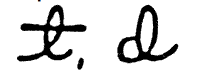
3. Looped letters (t's, y's, d's, ect.)

4. Smoothed tops (m's, n's ect.)

5. Slanted letters or lines
 6. Sharp letters

7. No 'tails' / long 'tails'

8. Distinct letters


11. Dragged marks (dots for i's & j's, ect.)

12. Open or closed letters (o's, d's, g's, ect.)
Handwriting Analysis: History
- Handwriting analysis dates back as far as the 1600s, when people started to notice the distinctness between the writing & their handwriting
- In 1873, Hypolite Michon & Jules Crepieux-Jamin developed the School of Isolated Signs, in attempt to relate specific traits to handwriting
- In 1910, Milton Newman Bunker (a teacher) was curious about the spacing in his letters compared to the way other people wrote
- He found the shapes & formations of individual specific letters was unique to each person's handwriting
- With his curiosity, handwriting analysis was born

Hair/Fiber: Notable Case
In 1994, a woman was murdered with what seemed to be no traces of a killer. However, the only thing found on her was a few pieces of cat hair. The cat hair was analyzed and matched up to a Canadian man's cat. The woman's body was found in a shallow grave a few months after she disappeared & the police suspected her former husband. The cat hairs were found on a jacket stuffed into a plastic bag in the woods & they matched Stepehn J. O'Brien. This was one of the few cases in history where a person was convicted of murder on something other than human hair.


Hair/Fiber: Reliability
- The hair from a human head has odds of 4500 to 12 from coming from the same person, which is .0022%
- Fibers are different, as there are many different fibers in existence
- It depends on how 'rare' that fiber is or how much is found
- Fibers are very common on the crime scene, found on the victim, their clothes, their fingernails, ect.
- As they're so common, it can be difficult to find & test all fibers from a scene

Subscribe to:
Posts (Atom)